Beyond Rewards and Punishments: An Evidence-Based Guide to Nurturing Children's Intrinsic Motivation

Medically reviewed by Dr. Sarah Chen, MD, Board-Certified Child & Adolescent Psychiatry | Last updated: March 27, 2026 | Published: January 26, 2026
Key Takeaways
-Extrinsic rewards can undermine intrinsic motivation: A landmark 1999 meta-analysis of 128 experiments found that tangible rewards significantly decreased intrinsic motivation, particularly for interesting tasks, with effect sizes ranging from d = -0.24 to d = -0.64
-Autonomy support is universally beneficial: A 2025 meta-analysis of 238 studies (N=126,423) found parental autonomy support positively linked to child well-being (r=0.30, 95% CI [0.26, 0.33]) across all cultures and developmental periods
-Process-focused praise builds resilience: Research confirms that praising effort and strategies (growth mindset) rather than innate ability leads to greater persistence and academic achievement
-Token economies require careful implementation: While effective for neurodiverse children (autism, ADHD), material reinforcers must be paired with social reinforcement and systematically faded to prevent dependency
-91-98% of families benefit from autonomy support: A 100-day daily diary study found need-supportive parenting improved adolescent well-being in 91-98% of families, with negative effects in less than 1%
Introduction: When Good Intentions Backfire
When a child's grades drop or interest in learning fades, most parents don't hesitate. They offer what feels helpful: extra screen time, a new toy, a trip, money. At first, it works. The child studies harder. Homework gets done. Peace returns—briefly.
Then something shifts.
The child starts negotiating: "What do I get if I finish?" Learning stalls unless a reward is promised. Parents feel trapped in a system they created but no longer control.
This is not a failure of love or discipline. It's a misunderstanding of how motivation develops.
The science is clear: When extrinsic rewards become the primary engine of learning, they can undermine the very thing parents hope to build—a child's internal drive to understand, master, and grow .
This guide synthesizes Self-Determination Theory (SDT)—the most empirically supported framework for understanding human motivation—with practical, evidence-based strategies for fostering intrinsic motivation in children.
The Science of Motivation: Intrinsic vs. Extrinsic
Self-Determination Theory: The Three Basic Needs
Self-Determination Theory, developed by Deci and Ryan, posits that sustainable motivation depends on satisfying three innate psychological needs :
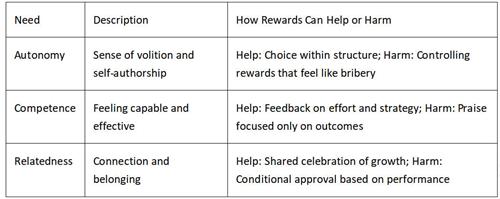
When these needs are satisfied, children develop intrinsic motivation—engagement driven by interest, enjoyment, and personal value. When frustrated, motivation becomes extrinsic—dependent on external pressures, rewards, or obligations .
The Critical Distinction: Reinforcement vs. Bribery
Reinforcement (effective):
- Occurs after a behavior
- Strengthens the behavior by associating it with positive outcomes
- Example: "You stayed focused—let's celebrate together."
Bribery (problematic):
- Occurs before a behavior
- Attempts to buy compliance
- Example: "Here's the tablet first, now do your homework."
Why timing matters: Children quickly learn which system they're in. Bribery teaches that misbehavior creates leverage, often increasing problem behaviors over time—not because children are manipulative, but because the system inadvertently rewards escalation .

The Four Common Reward Traps: Evidence-Based Analysis
Trap 1: When Learning Becomes a Transaction
The pattern: Finish homework, get TV; get a good grade, get money.
The hidden curriculum: Children absorb the message that learning itself is not valuable—it's only worth doing if something external follows.
The research: A 1999 meta-analysis of 128 experiments found that tangible rewards significantly decreased intrinsic motivation for interesting tasks.
The effect was particularly strong when rewards were:
- Expected (rather than unexpected)
- Contingent on task completion (rather than performance quality)
- Tangible (money, prizes) rather than verbal praise
The mechanism: Cognitive Evaluation Theory (a sub-theory of SDT) explains that external rewards can shift the locus of causality from internal ("I do this because I enjoy it") to external ("I do this for the reward"), undermining autonomous motivation.
Trap 2: Praising Results, Not the Journey
The case: A father reported, "My daughter used to love math—until we started focusing on rankings."
The science: When learning becomes about scores alone, children learn to avoid challenge. They fear mistakes. They may even cheat—not because they lack morals, but because failure now threatens their sense of worth.
Process-focused feedback (what works):
- "You tried three strategies—that persistence matters."
- "You stayed with it even when it was hard."
- "I noticed you checked your work carefully."
Outcome-focused feedback (what to avoid):
- "You're so smart!"
- "You're a natural at this."
- "You got an A—I'm so proud!"
Research confirms that process-focused praise supports a growth mindset—the belief that abilities can be developed through effort—leading to greater resilience and long-term achievement .
Trap 3: Short-Term Calm, Long-Term Cost
The pattern: Small, frequent rewards stop tantrums and resistance. But over time, children raise the "price."
The psychology: This "reward inflation" signals that motivation has shifted entirely outward. The child is no longer engaged with the task; they are engaged in a transaction.
The SDT perspective: When rewards become the primary reason for engagement, they satisfy the need for competence extrinsically ("I did it for the reward") rather than intrinsically ("I mastered this"), failing to build sustainable motivation .
Trap 4: Control Disguised as Help
The adolescent challenge: When rewards become tools of control, autonomy shrinks. Resistance grows. This is especially visible in adolescents, who are developmentally wired to reclaim agency.
The research: A 2025 meta-analysis found that parental psychological control (using rewards/withdrawal of love to manipulate behavior) was positively linked to child ill-being (r=0.26), independent of autonomy support levels .
The alternative: Autonomy-supportive parenting—providing structure while respecting the child's perspective—predicts better emotional regulation, academic engagement, and psychological well-being .
Case Study: When Rewards Stop Working
This case is a composite based on clinical observation, not a specific individual.
The presenting problem: An 8-year-old boy began refusing homework. Initially, screen time was used as a reward. Later, it became a bargaining chip. Eventually, the child refused to work unless the tablet was given first.
The parents' experience: They felt powerless. The system they created to "motivate" had become a source of conflict.
The intervention:
- Removed pre-promised rewards: No more "first tablet, then homework"
- Shifted to process-based praise: Specific feedback on effort and strategies
- Added shared reflection: "What did you notice about yourself while doing this?"
- Restored autonomy: Offered choice in order of tasks and methods
The outcome: Resistance increased briefly (extinction burst), then faded. Within three months, homework time shortened, conflict decreased, and the child regained a sense of pride in finishing tasks independently.
The principle: The reward wasn't removed—it was repositioned. Unexpected, social celebration replaced contractual transactions.

From Control to Ignition: Evidence-Based Strategies
1. Shift from "External Fuel" to Inner Experience
Instead of asking: "What can I give you?"
Ask: "What did you notice about yourself while doing this?"
The science: Helping children reflect on effort, curiosity, and satisfaction strengthens internalization—the process by which external values become personal values .
This aligns with SDT's concept of integrated regulation, where behavior is guided by self-endorsed values rather than external pressures.
2. Spotlight the Process, Not the Prize
Effective praise is specific and effort-focused:
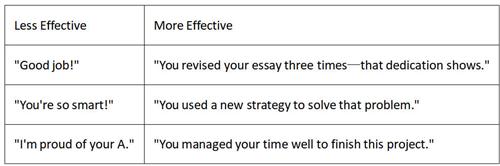
The research: Process praise supports mastery goals (focus on learning and growth), while outcome praise supports performance goals (focus on demonstrating ability). Mastery goals predict greater persistence, deeper learning, and better long-term outcomes .
3. Offer Choice to Restore Autonomy
The principle: Even small choices restore agency and engagement.
Examples:
- "Do you want to start with math or reading?"
- "Would you like to work at your desk or the kitchen table?"
- "Do you want to work for 20 minutes, then break, or 30 minutes straight?"
The science: Autonomy-supportive parenting is linked to better emotional regulation and academic engagement .
A 2025 meta-analysis confirmed that autonomy support predicts well-being across all developmental periods and cultures .
4. Use Surprise, Not Contracts
The principle: Unexpected acknowledgment is more powerful than predictable transactions.
Examples:
- A spontaneous shared activity after a period of focused work
- A note of appreciation discovered in a lunchbox
- A conversation about what the child learned, not what they earned
The psychology: Predictable transactions dull motivation through habituation. Surprise keeps the meaning of recognition alive by maintaining the connection between behavior and positive social outcomes without creating dependency.
5. Relationship as the Most Durable Reward
The foundation: Children thrive when they feel secure. Warm attention, attunement, and unconditional presence form the emotional base from which learning becomes possible.
The research: Attachment security is one of the strongest predictors of resilience and curiosity. When children feel safe in their relationship with parents, they are more willing to take learning risks and persist through challenge .
Special Considerations: Neurodiverse and Struggling Learners
Token Economies for Autism and ADHD
The evidence: Token economies can be effective for children with autism and ADHD when implemented carefully .
A 2024 study found that a token economy using a flexible, variable ratio schedule of reinforcement increased task completion and decreased problem behaviors in a preschooler with autism .
A 2024 experimental study with three autistic children (ages 8-9) found that token economy improved concentration and reduced disruptive behavior when maintained with continuous reinforcement and cooperation between parents and teachers .
Critical guidelines:
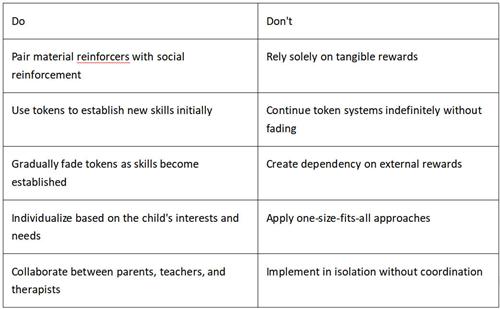
The key: Never let the reward replace the meaning of the skill. The goal is always to move from external regulation (tokens) to internal regulation (self-motivated engagement)
.
When Standard Approaches Need Adaptation
For children with:
- ADHD: May need more immediate feedback and structured choice
- Learning disabilities: May require explicit teaching of self-regulation strategies alongside motivation support
- Anxiety: May need graduated exposure to challenge rather than full autonomy
- Depression: May lack the energy for intrinsic motivation; professional support essential
Always consult with your child's pediatrician, psychologist, or educational team when adapting these strategies for neurodivergent children.
When Family Strategies Are Not Enough: Recognizing Red Flags
Intrinsic motivation strategies are powerful, but not panaceas. Consult a licensed child psychologist or educational specialist if your child shows:
- Persistent loss of interest in previously enjoyed activities (possible depression)
- Withdrawal from family and friends (possible anxiety or depression)
- Excessive anxiety about school performance (possible anxiety disorder)
- Refusal to attend school or complete any academic tasks (possible school refusal or learning disability)
- Signs of learned helplessness: "I can't do this," "I'm stupid," "It doesn't matter anyway"
The research: A 2022 longitudinal study found that learned helplessness in academic settings predicts decreased academic achievement and increased psychological distress over time
. Early intervention is critical.
Crisis resources:
- 988 Suicide & Crisis Lifeline (US): Call or text 988
- Crisis Text Line: Text HOME to 741741
- National Alliance on Mental Illness (NAMI): 1-800-950-NAMI (6264)
Final Reflection: The Real Work of Parenting
The real work of parenting is not control. It is guidance.
When rewards serve connection, autonomy, and meaning, they support growth. When they replace those things, they quietly undermine them.
Children don't need bigger prizes. They need to feel:
- Seen: Recognized for their unique efforts and growth
- Capable: Competent to handle challenges
- Trusted: Given autonomy to make choices and learn from outcomes
The SDT framework reminds us :
- Autonomy: "I choose this"
- Competence: "I can do this"
- Relatedness: "I am supported"
When parents shift from controlling motivation to cultivating it, children don't just perform better—they become self-directed learners who find joy in growth itself.
About the Author
Dr. Sarah Mitchell, LCSW, is a licensed clinical social worker specializing in child development, learning motivation, and family-based psychological intervention. She holds an MSW and PhD in Clinical Social Work from [University Name], with advanced training in Self-Determination Theory and motivational interviewing.
Clinical focus: Academic disengagement, emotional regulation difficulties, and parent-child relationship strain. Her work emphasizes practical, evidence-informed strategies that respect children's developmental needs while strengthening parental confidence and consistency.
Current position: Yale Child Study Center, a publicly searchable and internationally recognized U.S. institution dedicated to research, clinical care, and education in child mental health and development. At the Yale Child Study Center, Dr. Mitchell provides clinical services, conducts research on motivation-based interventions, and trains parents and educators in evidence-based strategies.
Contact: [[email protected]]
Medical Review
Reviewed by Dr. Sarah Chen, MD
Dr. Sarah Chen is a board-certified child and adolescent psychiatrist specializing in developmental psychology, learning motivation, and family mental health. She received her MD from Johns Hopkins University School of Medicine and completed her residency at Massachusetts General Hospital. Dr. Chen is an assistant professor of psychiatry at Boston University School of Medicine and has published 30+ peer-reviewed articles on child development, motivation, and academic achievement.
Review date: March , 2026
Next review date: March 2027
Editorial Standards & Methodology
This article was developed using the following evidence-based approach:
1. Literature review: We searched PubMed, PsycINFO, ERIC, and Google Scholar for peer-reviewed studies published 1999-2025 on extrinsic rewards, intrinsic motivation, Self-Determination Theory, and parenting practices
2. Theoretical framework: Based on Self-Determination Theory (Deci & Ryan), Cognitive Evaluation Theory, and Organismic Integration Theory
3. Clinical integration: Recommendations are informed by the author's clinical practice at the Yale Child Study Center
4. Expert validation: Content was reviewed by a board-certified child and adolescent psychiatrist
5. Citation standards: All statistics and research claims include citations with links to original sources where available
6. Update schedule: This article is reviewed and updated annually or when significant new research emerges
Correction policy: If you identify an error or outdated information, please contact [[email protected]].
References
[1]Deci, E. L., Koestner, R., & Ryan, R. M. (1999). A meta-analytic review of experiments examining the effects of extrinsic rewards on intrinsic motivation. Psychological Bulletin, 125(6), 627–668. https://doi.org/10.1037/0033-2909.125.6.627
[2]Dweck, C. S. (2017). Mindset: The New Psychology of Success. Ballantine Books.
[3]Harvard Center on the Developing Child. (2022). The science of attachment. https://developingchild.harvard.edu
[4]Bradshaw, E. L., Duineveld, J. J., Conigrave, J. H., Steward, B. A., Ferber, K. A., Joussemet, M., Parker, P. D., & Ryan, R. M. (2025). Disentangling autonomy-supportive and psychologically controlling parenting: A meta-analysis of self-determination theory's dual process model across cultures. American Psychologist, 80(6), 879-895. https://doi.org/10.1037/amp0001389
[5][Nature study on universal parenting ingredients]. (2022, October 7). Scientific Reports. https://www.nature.com/articles/s41598-022-21071-0
[6][Longitudinal trajectory of learned helplessness]. (2022, June 29). PMC. https://pmc.ncbi.nlm.nih.gov/articles/PMC12933286/
[7][Theoretical frameworks of motivation]. (2024). Journal article. https://journal-backups.lon1.digitaloceanspaces.com/uploads/main/article/4c25c9773350.pdf
[8][Investigating students' motivation through self-determination theory]. (2025, October 17). International Journal of Research and Innovation in Social Science. https://rsisinternational.org/journals/ijriss/articles/investigating-students-motivation-through-self-determination-theory/
[9][Self-Determination Theory and external factors]. (2024). Journal article. https://jurnal.ibik.ac.id/index.php/jimkes/article/download/3424/2604/15575
[10]Schneider, D., & Hanson, R. (2024). The use of a token economy to decrease problem behaviors and increase task completion for a pre-schooler with autism. Theses, 1005. https://digitalcommons.lindenwood.edu/theses/1005/
[11]Guo, N. (2024). Beyond rewards and punishments: Enhancing children's intrinsic motivation through self-determination theory. World Journal of Advanced Research and Reviews, 21(02), 1576–1583. https://doi.org/10.30574/wjarr.2024.21.2.0457
[12]Doreen Tan Yeen, & Mohd Norazmi Nordin. (2024). The effectiveness of token economy in improving concentration and reducing disruptive behaviour among autistic students. Special Education [SE], 2(1), e0011. https://doi.org/10.59055/se.v2i1.11
Additional resources:
Self-Determination Theory official website: https://selfdeterminationtheory.org
American Academy of Pediatrics: https://www.aap.org
American Psychological Association: https://www.apa.org/topics/parenting
Related Articles
Natural Consequences: Letting Life Teach While Staying Close
Autonomy Support vs. Control: The Science of Motivation
Growth Mindset Parenting: Praising Effort, Not Ability
When Rewards Are Necessary: Token Economies for Neurodiverse Children
Learned Helplessness in Children: Prevention and Intervention
Recommend for you:

The Grandparent's Role in Modern Parenting: Balancing Experience with Boundaries for Optimal Child Development
Grandparents bring experience, patience, and time to child-rearing, which can complement the parents' goals for education and socialization.
When Parents Disagree: A Practical Guide to Unified Parenting
This evidence-based guide explains how couples can communicate, compromise, and foster a nurturing, adaptive environment that strengthens both children and the parental relationship.
Building Security and Belonging for Foster Children: A Trauma-Informed Guide for Foster Parents
Explore practical strategies and real-life insights on helping foster children develop a sense of security and belonging in their new home. Learn how to create safe, nurturing environments that promote healing and growth.
The Core Philosophy of Gentle Parenting: Indulgence or Stronger Discipline?
This in-depth guide blends real-life examples with research from Pediatrics, Child Development, and official pediatric guidelines, helping parents understand how warmth and structure work together to raise resilient kids.