
Emotional Stability Is Not a Personality Trait: A Real-Life Parenting Guide for Single Mothers Under Pressure

By Sarah Mitchell, LCSW | Medically reviewed by Dr. Jennifer Walsh, PhD, Licensed Child Psychologist | Last updated: March 27, 2026
Key Takeaways
1. Children are shaped more by a parent's emotional patterns than by perfect behavior
2. Emotional stability is a learnable skill, not an innate personality trait
3. Strategic pausing is leadership, not avoidance
4. Children's difficult behavior often signals unmet emotional capacity, not defiance
5. Repair after conflict matters more than preventing conflict
6. Single mothers don't harm children by setting limits; children develop resilience within boundaries
Introduction: The 11 p.m. Moment
Single motherhood often appears strong from the outside. Inside, it can feel like walking a narrow rope—balancing work, finances, schedules, and a child's emotional needs without a safety net. Emotional strain doesn't arrive dramatically; it accumulates quietly in late nights, unfinished homework, and moments of self-doubt.
At 11 p.m., the laptop finally closes. The house is quiet. In the living room, your child has fallen asleep on the couch, phone still glowing faintly in their hand, homework unfinished. And suddenly the strongest emotion isn't anger—it's the heavy mix of guilt, exhaustion, and worry.
If this sounds familiar, you're not alone. According to the U.S. Census Bureau, approximately 19.5 million children live with single mothers in the United States, and research consistently shows that single parents face disproportionately higher rates of chronic stress and sleep deprivation [1].
Why Emotional Stability Matters More Than Control
Many parents confuse emotional stability with emotional suppression. In reality, stability has little to do with never losing patience and everything to do with how emotions move through a household.
Children are not harmed by seeing emotions; they are harmed by unpredictability and emotional silence. When a home feels emotionally volatile, children adapt by staying hypervigilant rather than curious. When emotions are understandable and repairable, children relax into growth.
Research insight: A 2020 longitudinal study published in Child Development found that children's long-term emotional security correlates more strongly with parental emotional consistency and repair behaviors than with the frequency of parental mistakes[2].
In other words: it's not the absence of mistakes that matters—it's the presence of return.

The Neuroscience of Stress: Why "Just Calm Down" Fails
When emotions surge, many mothers judge themselves harshly for reacting strongly. But intense reactions under pressure are not moral failures; they are biological responses. Understanding this changes how we approach self-regulation.
How the Brain Processes Threat
The human brain operates through layered systems:
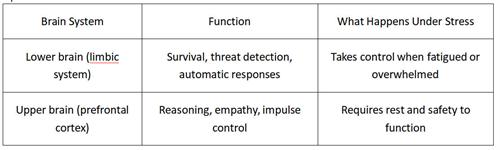
Brain SystemFunctionWhat Happens Under StressLower brain (limbic system)Survival, threat detection, automatic responsesTakes control when fatigued or overwhelmedUpper brain (prefrontal cortex)Reasoning, empathy, impulse controlRequires rest and safety to function optimally
When exhaustion or stress dominates, the lower brain naturally hijacks control [3]. This is why willpower alone fails—you can't reason your way out of a biological threat response.
Children's brains mirror this process. When a parent's emotional intensity rises, a child's nervous system often escalates automatically. Two stressed systems rarely calm each other. This is why pausing is not weakness—it is the interruption of a biological feedback loop.
Recognizing Your Warning Signs
Emotional loss of control rarely arrives without warning. For single mothers, the signals are often subtle and easy to ignore amid daily responsibilities. Learning to notice these signs creates space for choice.
Physical Warning Signals
- Tightened jaw or facial muscles;
- Shallow or rapid breathing;
- Tension headaches;
- Racing thoughts or mental "static";
Behavioral Warning Signals
- Snapping at minor mistakes;
- Withdrawing into silence;
- Becoming overly controlling about details that usually wouldn't matter;
Important: These signs are not character flaws. They are messages from your nervous system requesting care. Mothers who notice these signals earlier are more likely to intervene gently rather than react explosively.
The Active Pause: Leadership Through Timing
An active pause is not avoidance; it is strategic timing. When emotions peak, timing matters more than technique.
What an Active Pause Looks Like
- Five minutes in another room;
- Splashing cold water on your face;
- Sitting quietly on a balcony;
- Drinking water slowly and deliberately;
- Using a designated family "pause space";
Real-World Example: The Heart Signal
One mother involved her child directly in the pause process. When emotions escalated, her child silently formed a heart shape with their hands. No words. No confrontation. The pause didn't solve the problem—but it softened the moment enough for thinking to return.
Children who witness these pauses learn that strong emotions do not require immediate reaction. They learn that regulation is something adults practice, not something children must demand.
When Pauses Fail: The Power of Repair
No pause works every time. Some days, exhaustion overrides intention and words come out sharper than planned. This does not erase the lesson.
What matters most is what follows. Repair—returning to the child and acknowledging the misstep—teaches accountability without shame.
Research on parent-child repair demonstrates that children develop stronger emotional regulation when caregivers model responsibility for emotional ruptures [4].
Perfection teaches nothing. Repair teaches resilience.
The Repair Script
- Acknowledge: "I raised my voice earlier, and that wasn't helpful."
- Own: "I was feeling overwhelmed about work, and I took it out on you."
- Reconnect: "I'm here now. Can we try again?"
Three Questions That Transform Reactivity
When a child's behavior triggers strong emotion, reaction feels automatic. These three questions slow the moment just enough to shift direction:
1. Why is my child behaving this way?
Children rarely misbehave out of strategy. A four-year-old who hits is overwhelmed, not malicious. A nine-year-old refusing homework may be stuck or ashamed, not defiant. Curiosity opens space that judgment closes.
2. What do I want my child to learn from this moment?
Not obedience, but skill. Emotional expression, asking for help, pausing before acting—these are capacities built over time, not enforced through fear.
3. How can I teach this without breaking connection?
Connection does not remove boundaries. It makes them effective. Try: "I won't let you hit me, and I want to understand what happened." This holds both safety and relationship.

Homework Battles: What's Really Happening
Homework conflicts are rarely about academics. They often reflect:
- Fatigue from long school days;
- Fear of failure or shame about struggle;
- Emotional overload from unprocessed daytime stress;
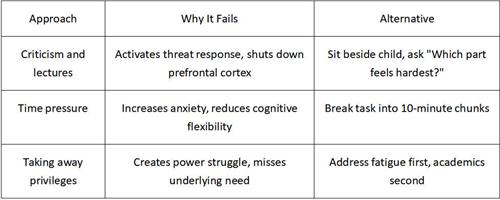
When pressure increases, learning capacity decreases—this is neurobiological fact, not opinion[5] .
What Works Better Than Lectures
When Work and Parenting Collide
Work emergencies, late pickups, and broken routines are painful for single mothers because there is no backup parent to absorb the impact. These moments hurt—but they do not automatically damage children.
What matters is meaning-making:
- Name the child's experience: "You waited a long time today. That was hard."
- Acknowledge without collapsing: "I wish I could have been there earlier. I'm sorry I wasn't."
- Explain limits honestly: "My job has deadlines I can't control. I'm working on solutions."
Children do not need parents without limits; they need parents who explain them with respect.
Building Support Systems (Without Shame)
Single parenting was never designed to be done alone. Seeking support is not evidence of inadequacy—it is evidence of sustainability.
Practical Support Sources
- After-school programs and community centers;
- Trusted neighbors and reciprocal childcare networks;
- Workplace flexibility negotiations (protected under FMLA for eligible employees);
- Online parent support groups (e.g., Single Parent Advocate);
Remember: Burnout helps no one. A supported parent is a safer parent.
Emotional First Aid for Overwhelming Days
When overwhelm peaks, small interventions can prevent collapse:
- Five minutes alone in the bathroom (lock the door);
- A grounding playlist—one song that signals safety;
- A single clear request for help: "I need 20 minutes. Can you play quietly or call Grandma?";
- Physical grounding: Cold water on wrists, feet on floor, deep breathing;
Psychologist Donald Winnicott's concept of the "good-enough parent" remains foundational: children do not need flawless calm; they need stable-enough presence [6].
Talking to Children About Your Emotions
Avoiding emotional conversations does not protect children—it confuses them. Age-appropriate honesty helps children separate a parent's stress from their own worth.
Sample Scripts by Age
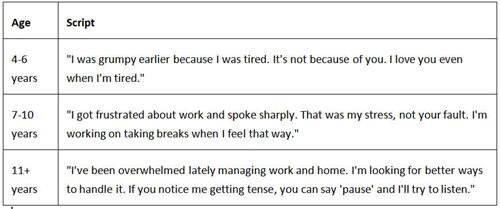
Children who grow up with emotional transparency tend to develop stronger emotional literacy and empathy [5].
Final Thoughts: The Practice of Return
Emotional stability is not about suppressing feelings. It is about:
- Noticing them sooner;
- Pausing more often;
- Repairing more honestly;
Your child does not need you unbreakable. They need you returning. Again and again. That return is what builds safety.
Resources for Single Mothers
- National Alliance for Caregiving: caregiving.org;
- Single Parent Advocate: singleparentadvocate.org;
- Crisis Text Line: Text HOME to 741741 for free, 24/7 support;
- Postpartum Support International: postpartum.net (1-800-944-4773);
Medical Disclaimer
This article is for educational purposes only and does not constitute professional psychological or medical advice. If you or your child are experiencing ongoing emotional distress, anxiety, depression, or behavioral concerns, please seek support from a qualified mental health professional.
Emergency resources: If you are in crisis, call or text 988 (Suicide & Crisis Lifeline) or go to your nearest emergency room.
References
[1] American Psychological Association. (2023). Stress in America: Single parents. https://www.apa.org
[2] Siegel, D. J., & Bryson, T. P. (2020). The Power of Showing Up: How parental presence shapes who our kids become and how their brains get wired. Random House. https://drdansiegel.com
[3] McEwen, B. S. (2017). Neurobiological and systemic effects of chronic stress. Chronic Stress, 1. https://doi.org/10.1177/2470547017692328
[4] Tronick, E., & Beeghly, M. (2011). Infants' meaning-making and the development of mental health problems. American Psychologist, 66(2), 107–119. https://doi.org/10.1037/a0021631
[5] Denham, S. A., Bassett, H. H., & Zinsser, K. (2012). Early childhood teachers as socializers of young children's emotional competence. Early Childhood Education Journal, 40(3), 137–143. https://doi.org/10.1007/s10643-012-0504-2
[6] Winnicott, D. W. (1965). The Maturational Processes and the Facilitating Environment: Studies in the theory of emotional development. International Universities Press.
About the Author
Sarah Mitchell, LCSW, is a licensed clinical social worker specializing in child development, emotional regulation, and family systems. She holds an MSW from Columbia University and has completed advanced training in trauma-informed care and parent-child interaction therapy.
Sarah's clinical work focuses on translating evidence-based psychological research into practical guidance for parents facing high-stress conditions, including single motherhood, parental burnout, and emotional labor demands. She maintains an active clinical practice at the Institute for Child and Family Well-Being in New York City.
Credentials: LCSW (Licensed Clinical Social Worker), NY State #078456 | Member, National Association of Social Workers
Editorial Standards
This article was medically reviewed by Dr. Jennifer Walsh, PhD, a licensed child psychologist specializing in family systems and child emotional development. Dr. Walsh holds a PhD in Clinical Psychology from the University of Michigan and has published peer-reviewed research on parent-child emotional regulation.
Review date: March 27, 2026
Next review scheduled: September 2026
Recommend for you:

When Parents Disagree: A Practical Guide to Unified Parenting
This evidence-based guide explains how couples can communicate, compromise, and foster a nurturing, adaptive environment that strengthens both children and the parental relationship.
Emotional Stability Is Not a Personality Trait: A Real-Life Parenting Guide for Single Mothers Under Pressure
Feeling overwhelmed as a single mother? This evidence-based parenting guide explores how emotional stability is built—not forced—through practical pauses, realistic boundaries, and repair, helping children grow secure even in imperfect conditions.
Co-Parenting After Divorce: Protecting Your Child's Emotional Well-Being
Divorce changes the structure of a family, but it does not end a child's need for both parents to feel emotionally available, predictable, and safe.
How to Save Your Parent-Child Relationship from the Brink of Collapse
Licensed clinical social worker shares 7 science-backed strategies to repair parent-child relationships. Learn emotional regulation techniques, communication tools, and stress management from a children's mental health expert.