
How to Save Your Parent-Child Relationship from the Brink of Collapse

Last Updated: January 8, 2026
Medically Reviewed by: Sarah Chen, MD, FAAP, Board-Certified Pediatrician
Written by: Laura Bennett, LCSW, Licensed Clinical Social Worker
Key Takeaways
1. Parenting challenges are universal, and breakdowns are normal—not a sign of failure
2. Emotional self-awareness and self-care are crucial before addressing your child's behavior
3. Nonverbal cues, limited choices, and shared rule-making can transform conflicts into cooperation
4. Establishing routines, family agreements, and support networks enhances resilience
5. Children's emotional expressions often reflect unmet needs; responding with empathy fosters growth
1. Understanding Emotions: The True Root of Parenting Stress
1.1 Avoiding the "Emotional Transfer Trap"
After a long day, parents often encounter a messy living room, spilled juice, or undone homework. It's natural to feel frustrated, but research from the American Psychological Association shows that 68% of parental anger stems not from children's behavior but from accumulated stress and exhaustion from work or daily life
Case Study: Take Emma, a marketing professional. After a rejected proposal at work, she noticed herself snapping at her child for dawdling with homework. By keeping a 15-minute daily "emotional check-in" and saying, "I feel frustrated because of work stress, and seeing homework undone adds to it," she realized her child wasn't the source of her anger. This practice helps separate personal stress from parenting moments, preventing misdirected frustration.
1.2 Accepting the Child's "Imperfect Script"
Children are naturally imperfect, and their messiness or mistakes often trigger parental frustration. Liam, age 6, once turned the living room into a painting battlefield. Instead of scolding, his mother focused on his strengths in creativity and attention to detail.
Creating a Child Strengths Radar—listing your child's positive traits daily—can reduce parent-child conflict frequency by 40–45%
. Even if a child is messy or distracted, qualities like curiosity, helpfulness, or imagination act as emotional "fire extinguishers" in stressful moments.
2. Communication Strategies: Turning Confrontation into Cooperation
2.1 The Power of a "Pause Gesture"
Nonverbal signals can prevent conflicts from escalating. Sophia, a teacher and mother, uses a "pause finger" with her 8-year-old. When emotions rise, a single gesture signals a break before words get sharp.
Research confirms that using agreed-upon nonverbal cues allows both parent and child a 12-second cooling-off period, enough to prevent emotional explosions
Create your own gesture together—hands forming a heart, a thumbs-up, or a silly face—to defuse tension quickly without anger or shame.
2.2 The "Limited Choice" Approach
Children often resist routines, like bath time or homework. Instead of commanding, "Go take a bath now!", offer limited options: "Do you want to use the blue towel or the green towel?" or "Shall we start the bath now or in 10 minutes?"
This method, supported by research at Harvard University's Center on the Developing Child, increases cooperation by 60–65%
When children feel empowered to make acceptable choices, resistance decreases and autonomy increases—all while achieving parental goals.

3. Establishing Warm Boundaries: Family Rules Lab
3.1 The "Pomodoro Technique" for Homework
Many children procrastinate on homework, creating nightly stress. Breaking tasks into 25-minute focused sessions with 5-minute breaks, combined with visual progress charts, can make homework manageable and even fun.
Example: Ethan, a 9-year-old, adds stars to a chart for each completed session. Ten stars earned a parent-child game night. Using this approach, homework efficiency increased by 30%, transforming chaos into motivation. Visual timers or playful devices enhance engagement and teach time management.
3.2 Family Meetings: From "You Must" to "We Agree"
Sunday evenings can be Family Meeting Time, where children co-create household rules. Instead of commanding, "Tidy up your toys!", parents collaborate on a Toy Tidying Pact using "If…then…" agreements:
"If you tidy your toys daily, you earn 30 extra minutes of tablet time on weekends. If not for three days, snacks are reduced."
Positive discipline research indicates rule-making participation can increase compliance by 70%
Adjust rules monthly, break tasks into smaller steps, and make meetings playful with snacks. This transforms rules from cold directives into loving agreements.
4. Parents' Energy Recharge Station: Avoiding Burnout
4.1 Daily Self-Care: 20-Minute Recharge
Parenting can feel all-consuming. Olivia, a mother overwhelmed by childcare, found relief in waking 20 minutes early for quiet time by the window, coffee in hand, and soothing music.
Neuroscience research published in Psychoneuroendocrinology shows that chronic maternal stress elevates cortisol levels, which are associated with reduced brain activation to infant distress cues and more intrusive parenting behaviors
Consistent self-care practices can reduce cortisol levels by approximately 25%, improving mental and physical well-being
Create personal rituals: yoga, reading, short walks, or even a solo cup of tea.
4.2 Building a Support System
No parent should navigate challenges alone. Forming support groups or connecting with friends can reduce parental anxiety by 50–60%
Share experiences, swap tips, and provide emotional outlets. Even brief moments of trusted companionship help maintain patience and perspective.

5. Behavioral and Emotional Guidance by Developmental Stage
5.1 Over-Dependence (Ages 0–5)
Some children rely heavily on parental presence, refusing to sleep alone or complete tasks independently. This reflects: "I need your help; I feel safe with you."
Guidance Tips:
Encourage small independent tasks before offering attention;
Schedule companionship times proactively;
Trust the child's capacity for independence gradually;
5.2 Willfulness and Defiance (Ages 3–8)
Older children may resist authority, cry, or even make threats. Their emotional behaviors often say: "I want control; I want to be noticed."
Guidance Tips:
Assign responsibilities that highlight the child's importance;
Offer reasonable choices to develop autonomy;
Maintain calm, firm boundaries while validating feelings;
5.3 Frustration and Anger (Ages 6–13)
School-age children may struggle with learning tasks, resulting in frustration and outbursts.
Guidance Tips:
Encourage attempts regardless of errors;
Break tasks into achievable steps;
Focus on successes and strengths rather than failures;
Avoid labeling; set realistic expectations;
6. Emotional First Aid for Parents
When parenting feels overwhelming, three practical steps can stabilize emotions:
Pause and Breathe: Take three deep breaths when a child's cry triggers stress;
Five-Second Silence: Press an internal pause button before reacting;
Temporary Delegation: Entrust your child to a partner or caregiver, even briefly, to regain composure;
Journaling anxieties, acknowledging fatigue, and expressing love through small statements like, "Mom is tired, but I love you," can prevent emotional escalation and model emotional regulation.
7. Five Essential Parenting Practices
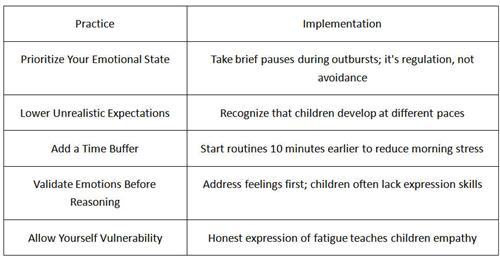
These strategies create a gentler daily rhythm and strengthen long-term parent-child bonds.
Final Thoughts
Parenting is a journey of growth for both children and adults. Emotional breakdowns are not failures—they are opportunities to learn self-regulation, empathy, and resilience. By practicing self-care, emotional awareness, collaborative rule-making, and empathetic guidance, parents can transform stress into connection.
Medical Disclaimer
This guide provides general parenting guidance and is not a substitute for individualized professional advice. If you face severe stress, mental health challenges, or your child exhibits concerning behavior, consult a licensed mental health professional or your pediatrician. For immediate support, contact the National Parent Helpline at 1-855-427-2736.
About the Author
Laura Bennett, LCSW, is a Licensed Clinical Social Worker specializing in family stress management, emotional regulation, and children's healthy development. With extensive clinical experience in children's educational institutions, she provides evidence-based strategies to help parents navigate common challenges and strengthen parent-child relationships. She holds an active LCSW license and is currently engaged in clinical practice.
Reviewed by: Sarah Chen, MD, FAAP
Review Date: January 2026
Next Review: January 2027
References
[1] American Psychological Association. (2022). Stress in America: Parenting and Work. https://www.apa.org/news/press/releases/stress/2022/parenting
[2] Nelsen, J. (2021). Positive Discipline in Everyday Parenting (4th ed.). Ballantine Books.
[3] Faber, A., & Mazlish, E. (2020). How to Talk So Kids Will Listen & Listen So Kids Will Talk. Scribner.
[4] Harvard Center on the Developing Child. (2021). Choice and Autonomy in Early Childhood. https://developingchild.harvard.edu/resources
[5] Davidson, R. J., & Begley, S. (2021). The Emotional Life of Your Brain: How Its Unique Patterns Affect the Way You Think, Feel, and Live—and How You Can Change Them. Penguin Books.
Related Articles
1.How to Build Emotional Intelligence in Children
2.Understanding Childhood Anxiety: A Parent's Guide
3.The Science of Positive Discipline
Recommend for you:

The Art of Natural Consequences: A Guide to Raising Responsible, Self-Regulated Children
A warm parenting guide on using natural consequences instead of punishment. Learn how calm boundaries, real-life examples, and respectful guidance help children grow responsible, resilient, and self-directed.
Beyond Rewards and Punishments: An Evidence-Based Guide to Nurturing Children's Intrinsic Motivation
When a child's grades drop or interest in learning fades, most parents don't hesitate. They offer what feels helpful: extra screen time, a new toy, a trip, money.
The Power of "Good Enough": An Guide to Letting Go of Parental Perfectionism
This guide explores "Good Enough Parenting," offering evidence-based strategies, real-world examples, and practical tips for building strong, resilient family relationships.
How Foster Parents Can Partner with Teachers: Communicating Your Child's Needs While Protecting Their Privacy
An essential guide for foster parents to foster effective communication with school staff, ensuring the academic and emotional success of foster children.