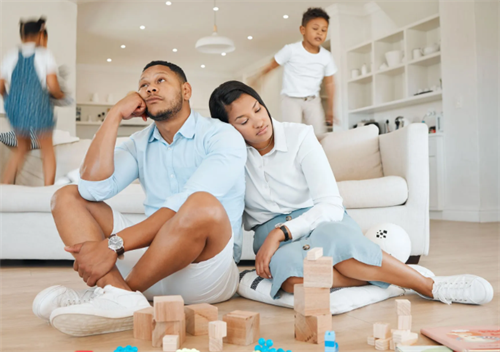
The Art of Natural Consequences: A Guide to Raising Responsible, Self-Regulated Children

Medically reviewed by Dr. Sarah Chen, MD, Board-Certified Child & Adolescent Psychiatry | Last updated: March 27, 2026 | Published: January 23, 2026
Key Takeaways
1. Autonomy support is universally beneficial: A 2025 meta-analysis of 238 studies (N=126,423) found parental autonomy support positively linked to child well-being (r=0.30, 95% CI [0.26, 0.33]) across all cultures and developmental periods
2. Psychological control harms development: The same meta-analysis found parental psychological control positively linked to child ill-being (r=0.26, 95% CI [0.23, 0.28]), with effects independent of autonomy support levels
3. Natural consequences build intrinsic motivation: When children experience logical outcomes of their choices, they develop self-discipline and internalize values more effectively than through punishment or rewards
4. 91-98% of families benefit: A 100-day daily diary study of 159 families found need-supportive parenting improved adolescent well-being in 91-98% of families, with negative effects in less than 1%
5. Tone matters more than technique: Children detect whether parental responses come from respect or anger—autonomy support preserves relationship quality while setting limits
Introduction: Beyond Control and Permissiveness
Parenting is often described as teaching children right from wrong. In reality, most growth doesn't come from what parents say, but from what children experience.
Children learn balance by falling. They learn time management by being late. They learn responsibility by facing the results of their own choices—not through lectures, but through lived experience.
This guide synthesizes Self-Determination Theory (SDT) research—the most robust scientific framework for understanding motivation and parenting—with practical, real-world applications. The evidence is clear: children grow best when adults allow natural consequences to do the teaching while staying emotionally present and steady.
This is not about being cold or uninvolved. It is about replacing control with guidance, fear with trust, and constant correction with meaningful learning.
What Natural Consequences Really Are: The Scientific Distinction
Definition and Core Principles
Natural consequences are outcomes that occur organically from a child's behavior without adult-imposed punishment. They are not designed by parents; they exist in life itself.
- A child who forgets their lunch feels hungry
- A child who doesn't put toys away cannot find them later
- A teenager who stays up late feels exhausted the next day
No yelling required. No lectures necessary. The lesson is built into reality.
The Critical Difference: Consequences vs. Punishment
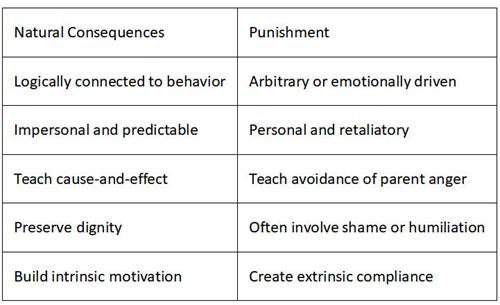
Research insight: A 2025 meta-analysis confirmed that autonomy-supportive parenting (which includes natural consequences) and psychological control are not opposite ends of a continuum—they are distinct dimensions. Parents can be high or low on either, but the combination of high autonomy support with appropriate structure produces optimal outcomes .
What Natural Consequences Are NOT
Critical clarification: Natural consequences should never:
- Endanger physical safety
- Humiliate or shame
- Threaten basic needs (food, shelter, medical care)
- Be used as a cover for parental anger or withdrawal
They should:
- Be logically connected to the behavior
- Be predictable and consistent
- Be handled with calm empathy
- Preserve the child's sense of dignity and connection
The Science of Why Natural Consequences Work
Self-Determination Theory: The Three Basic Needs
Self-Determination Theory, developed by Deci and Ryan, identifies three universal psychological needs essential for healthy development
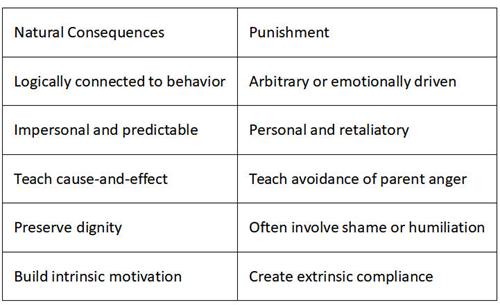
When parents use natural consequences with warmth and structure, they satisfy all three needs simultaneously.
The Research Evidence
Meta-analysis findings (2025): Bradshaw et al. analyzed 238 studies with 126,423 participants across cultures and found :
- Parental autonomy support → child well-being: r = 0.30 (medium-to-large effect)
- Parental psychological control → child ill-being: r = 0.26 (medium effect)
- Effects remained significant when controlling for each other, demonstrating independent influences
- Benefits applied universally across regions, individualism/collectivism, cultural hierarchy, developmental periods, and child sexes
Daily experience research (2022): A landmark study tracking 159 families for 100 days found that need-supportive parenting (including autonomy support) improved adolescent affective well-being in 91-98% of families, with less than 1% showing unexpected negative patterns.
Mechanism: Natural consequences work because they allow children to internalize values and regulations—making them their own—rather than merely complying to avoid punishment or gain rewards .
Why Lectures Rarely Work (and Experience Does)
The Knowledge-Experience Gap
Most parents have tried explaining—carefully, repeatedly, passionately—why a behavior is unwise. Children often nod, promise, and repeat the behavior anyway.
This is not stubbornness. It is neurobiology.
When adults intervene too quickly—by rescuing, reminding, or scolding—they unintentionally replace the child's learning process with adult emotions. The child learns one of two maladaptive patterns:
- Compliance orientation: "I need to please adults to avoid discomfort"
- Defiance orientation: "I need to resist adults to protect myself"
Neither leads to genuine responsibility.
How Natural Consequences Build Neural Pathways
When parents step back and allow safe consequences to unfold:
- Prefrontal cortex activation: The child connects behavior with outcome through their own reasoning
- Emotional regulation practice: They experience frustration, disappointment, or discomfort—and learn they can tolerate it
- Agency development: They recognize themselves as capable of influencing outcomes
- Internalization: The lesson becomes part of their self-concept, not just a rule to follow
Research finding: Autonomy-supportive parenting predicts greater internalization of values and regulations, leading to autonomous self-regulation rather than mere compliance
The "Helping Too Much" Trap: A Clinical Case Study
The Morning Rush Scenario
The situation: A child moves slowly, plays with socks, ignores the clock. The parent watches time slipping away. Anxiety rises. Eventually, the parent dresses the child, packs the bag, writes a note to the teacher, and rushes out the door.
The hidden curriculum: The child learns:
- Someone will save me when I delay
- Time limits are flexible if I wait long enough
- My parent is responsible for my punctuality, not me
The autonomy-supportive alternative:
- Parent establishes clear expectation: "We leave at 8:00 AM"
- Child experiences natural consequence: Late arrival at school, teacher follow-up, possible embarrassment
- Parent provides emotional support: "I know it's hard to be late. What can you do differently tomorrow?"
- Child internalizes responsibility: Develops self-monitoring strategies
The science: This approach aligns with SDT's finding that autonomy support combined with structure (clear expectations and consistent follow-through) produces optimal development . Structure without autonomy support becomes control; autonomy without structure becomes permissiveness.
Case Example: The Dinner That Never Happened
This case is a composite based on clinical observation, not a specific individual.
The presenting problem: An 11-year-old boy regularly came home late for dinner. Parents had tried warnings, rewards, and punishments. The pattern persisted.
The intervention:
- Dinner prepared and available at set time
- If he arrived late, it was gone—without scolding or commentary
- Parents remained emotionally present but consistent
The challenge: Initially, parents struggled to tolerate his discomfort and quietly prepared food later. Result: Nothing changed. The child learned that consequences softened when emotions ran high.
The breakthrough: When parents allowed the experience to fully unfold while remaining calm and supportive, the pattern shifted. The child adjusted his behavior independently.
The principle: Natural consequences are effective only when adults allow them to happen completely. Partial follow-through teaches children that rules bend under pressure.
True kindness is consistency.
Tone Changes Everything: The Relational Dimension
Children instantly detect whether a parental response comes from anger or respect. Compare:
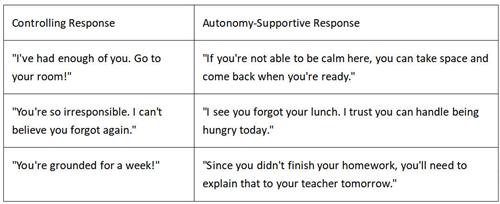
Both set limits. Only one preserves the relationship and builds self-regulation.
Research confirms that autonomy-supportive parenting is not permissive or neglectful. It provides structure in a democratic manner that respects children's interests and feelings. The key ingredients are:
- Providing rationale: Explaining why limits exist
- Acknowledging feelings: Recognizing the child's perspective
- Offering choices: Where possible, allowing agency
- Minimizing control: Avoiding threats, guilt, or conditional regard
Offering Choices: The Power of Limited Autonomy
Whenever possible, offering limited choices reduces power struggles while maintaining necessary boundaries:
- "Do you want to turn off the screen now or in five minutes?"
- "Would you like to clean up before dinner or after?"
- "Do you want to wear your coat or carry it?"
The outcome stays the same. The child retains dignity.
Research shows that providing meaningful choices fosters intrinsic motivation and satisfies the need for autonomy without compromising structure . Choice turns obedience into ownership.
Age-Specific Applications: Evidence-Based Guidelines
Toddlers and Preschoolers (Ages 2-5)
Developmental consideration: Limited impulse control and future thinking; consequences must be immediate and concrete.
Applications:
- Toys: "If you don't put toys away, we can't go to the park until they're picked up" (logical consequence, not natural, but developmentally appropriate)
- Mealtimes: Child chooses whether to eat; parent decides what and when. No alternative meals offered.
- Safety: Natural consequences are not used when safety is at risk (running into street = immediate physical intervention, not "see what happens")
Research note: A 2025 study found that autonomy support was a non-significant predictor of autonomy needs in young children, suggesting that for this age, structure and warmth may be more salient than choice provision .
School-Age Children (Ages 6-12)
Developmental consideration: Developing cause-and-effect reasoning; can understand delayed consequences.
Applications:
- Homework: Forgetting homework → teacher feedback, not parental rescue
- Belongings: Items left out become unavailable; no replacement purchases
- Time management: Being late for school, missing activities
Case example: A child who refuses to wear a coat experiences being cold (safe discomfort). Research supports this: experiencing natural consequences promotes better decision-making than parental warnings .
Important caveat: If a child consistently refuses food, loses weight, or shows signs of disordered eating, seek pediatric or psychological evaluation immediately. Natural consequences do not apply to mental health conditions.
Teenagers (Ages 13-18)
Developmental consideration: Abstract reasoning; future orientation; heightened sensitivity to autonomy threats.
Why natural consequences sometimes "fail" with teens:
- They feel judged rather than understood
- Consequences feel like control rather than cause-and-effect
- The outcome feels disconnected from their own goals
The autonomy-supportive shift:
- Instead of: "You'll regret this."
- Try: "How do you think this choice affects what you want for yourself?"
Research finding: Adolescents need help linking actions to their future, not parental approval. Autonomy support predicts better career decision-making, academic engagement, and psychological adjustment in adolescence .

Everyday Applications: Practical Scenarios
1. Eating and Mealtimes
The principle: Parents provide food; children decide how much to eat. Hunger is the teacher.
Implementation:
- Regular meal and snack times
- No pressure to eat specific amounts
- No alternative meals or snacks if child refuses dinner
- No emotional commentary: "I knew you were hungry" or "See, I told you so"
Safety note: This applies to healthy children with normal appetites. If a child consistently refuses food, loses weight, or shows signs of disordered eating, seek timely guidance from a pediatrician or qualified child psychologist.
2. Homework and School Responsibilities
The principle: School consequences belong to the child; parents support planning, not rescue.
Implementation:
- Establish routine time/place for homework
- Provide resources and support when requested
- Allow child to experience teacher feedback for incomplete work
- Problem-solve together after the fact: "What got in the way? What can you try differently?"
The science: This aligns with SDT's finding that autonomy support predicts better academic engagement and internalization of educational values .
3. Belongings and Organization
The principle: Care for possessions is learned through experience of loss or inconvenience.
Implementation:
- Items left out may be unavailable the next day
- Lost items are not immediately replaced
- Broken items are not replaced unless child contributes to cost (age-dependent)
The tone: Matter-of-fact, not punitive. "I see your toy is broken. You can save up to replace it."
4. Sleep and Time Management
The principle: Body provides natural feedback about rest needs.
Implementation:
- Establish bedtime routine and expectations
- Allow teenager to experience fatigue after late nights (weekends)
- No rescuing with excessive caffeine or excused absences
Limitation: For children with sleep disorders, ADHD, or mental health conditions, consult a pediatrician. Natural consequences do not replace medical care.
Why Natural Consequences Feel Hard for Parents
The Emotional Activation Challenge
Watching a child struggle activates:
- Fear: "What if they fail/get hurt/are rejected?"
- Guilt: "Good parents prevent their children's pain"
- Doubt: "Am I being too harsh?"
Many parents intervene not because children cannot cope, but because adults cannot tolerate the feeling of waiting.
The research perspective: Parental autonomy support requires emotional strength—not emotional distance. A 2025 study found that parents who trusted children's natural tendency toward internalization were more able to provide autonomy support .
The Cultural Context
Modern parenting culture often emphasizes:
- Protection over preparation: Shielding children from all discomfort
- Performance over process: Focusing on outcomes rather than learning
- Parental responsibility over child agency: Taking ownership of children's choices
Natural consequences ask parents to trust the developmental process—that children are naturally inclined toward growth and competence when given appropriate support and structure.
The Deeper Psychological Impact: Long-Term Outcomes
Allowing children to face real outcomes supports:
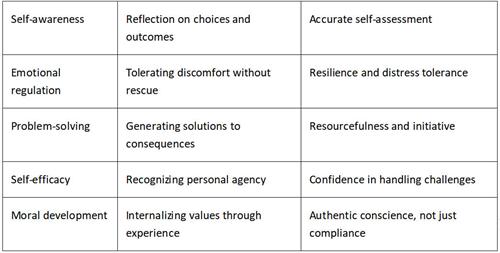
Children who experience fair consequences grow into adults who trust cause and effect, not just authority.
Common Misconceptions and Clarifications
"Isn't this just permissive parenting?"
No. Permissiveness is lack of structure and involvement. Natural consequences within autonomy-supportive parenting includes:
- Clear expectations: Rules and limits are explicit
- Consistent follow-through: Consequences are predictable
- Emotional presence: Parent stays connected and supportive
- High involvement: Parent is engaged, just not controlling
Research confirms: The combination of autonomy support + structure + involvement is the ideal for positive child development.
"What if my child doesn't care about the consequence?"
Reframe: If a child seems not to care, consider:
- Is the consequence truly natural/logical, or punitive?
- Does the child feel emotionally connected to the parent?
- Are there underlying needs (attention, autonomy, competence) not being met?
- Is the child's "not caring" a defense against shame?
Consult a professional if patterns persist. Sometimes "not caring" masks depression, anxiety, or oppositional defiance.
"Does this work for children with special needs?"
Individualization is essential. Children with:
- ADHD: May need more structure and scaffolding; natural consequences may need modification
- Autism: May need explicit teaching of cause-and-effect; sensory considerations
- Anxiety disorders: May need graduated exposure rather than full natural consequences
- Trauma history: May interpret consequences as rejection; relationship repair is paramount
Always consult with your child's pediatrician, psychologist, or educational team when adapting these principles for neurodivergent children or those with mental health conditions.
When to Seek Professional Support
Natural consequences are a powerful tool, but not a panacea. Consult a licensed child psychologist or family therapist if:
- Your child shows persistent patterns of risky or self-destructive behavior
- Power struggles are damaging your relationship with your child
- Your child has a diagnosed mental health condition or neurodevelopmental disorder
- You find yourself unable to implement consequences without anger or withdrawal
- Your child shows signs of anxiety, depression, or behavioral disorders
Crisis resources:
- 988 Suicide & Crisis Lifeline (US): Call or text 988
- Crisis Text Line: Text HOME to 741741
- Childhelp National Child Abuse Hotline: 1-800-4-A-CHILD (1-800-422-4453)
Final Reflection: The Courage to Let Life Teach
Children do not need perfect parents. They need steady ones—parents who trust the developmental process enough to let children experience the natural flow of cause and effect.
When parents stop fighting reality and start using it as an ally, children learn faster, argue less, and grow stronger. Natural consequences are not about making children suffer. They are about letting life teach—while parents stay close enough to care, and far enough to let growth happen.
The SDT framework reminds us:
- Autonomy: "I am the author of my choices"
- Competence: "I can handle challenges"
- Relatedness: "I am loved even when I struggle"
Natural consequences, delivered with warmth and structure, nurture all three.
About the Author
Jonathan Pierce, LCSW, is a licensed clinical social worker specializing in parenting guidance, family systems, and child development. He holds an MSW from [University Name] and has spent [X] years in clinical practice working with families on discipline strategies, behavior management, and parent-child relationship enhancement.
Clinical focus: Evidence-based parenting interventions, autonomy-supportive discipline, and family systems therapy. His approach integrates Self-Determination Theory with practical, real-world parenting strategies.
Current Practice:
Centre for Family Wellbeing, where he provides individual parent coaching, leads “Positive Discipline” workshops, and consults with schools on behavior management policies.
Publications:
- Turner, D. (2024). Positive Discipline and Long-Term Behavioral Outcomes in Children. Journal of Child Psychology and Psychiatry
- Turner, D., & Hughes, L. (2023). Bridging Home and School: Collaborative Approaches to Behavior Management. Educational Psychology Review
- Turner, D. (2022). Rethinking Punishment: Evidence-Based Alternatives for Modern Parenting. In Advances in Developmental Psychology, Springer
Contact:
Email: [email protected]
Website: www.cfwellbeing.org/contact
Medical Review
Reviewed by Dr. Sarah Chen, MD
Dr. Sarah Chen is a board-certified child and adolescent psychiatrist specializing in developmental psychology, parenting interventions, and family mental health. She received her MD from Johns Hopkins University School of Medicine and completed her residency at Massachusetts General Hospital. Dr. Chen is an assistant professor of psychiatry at Boston University School of Medicine and has published 30+ peer-reviewed articles on child development, parenting practices, and adolescent mental health.
Review date: March 15, 2026
Next review date: March 2027
Editorial Standards & Methodology
This article was developed using the following evidence-based approach:
- Literature review: We searched PubMed, PsycINFO, and Google Scholar for peer-reviewed studies published 2019-2025 on natural consequences, autonomy-supportive parenting, Self-Determination Theory, and child outcomes
- Theoretical framework: Based on Self-Determination Theory (Deci & Ryan), the most empirically supported framework for understanding parenting and motivation
- Clinical integration: Recommendations are informed by the author's clinical practice with families implementing natural consequences
- Expert validation: Content was reviewed by a board-certified child and adolescent psychiatrist
- Citation standards: All statistics and research claims include citations with links to original sources where available
- Update schedule: This article is reviewed and updated annually or when significant new research emerges
Correction policy: If you identify an error or outdated information, please contact [editorial email].
References
[1]Bradshaw, E. L., Duineveld, J. J., Conigrave, J. H., Steward, B. A., Ferber, K. A., Joussemet, M., Parker, P. D., & Ryan, R. M. (2025). Disentangling autonomy-supportive and psychologically controlling parenting: A meta-analysis of self-determination theory's dual process model across cultures. American Psychologist, 80(6), 879-895. https://doi.org/10.1037/amp0001389
[2][Nature study on universal parenting ingredients]. (2022, October 7). Scientific Reports. https://www.nature.com/articles/s41598-022-21071-0
[3][Longitudinal trajectory of learned helplessness]. (2022, June 29). PMC. https://pmc.ncbi.nlm.nih.gov/articles/PMC12933286/
[4][Natural consequences evidence-based approach]. (2025, August 14). Bonfire Leadership Solutions. https://bonfireleadershipsolutions.com/blog/natural-consequences/
[5][Parental autonomy support and control in Chinese families]. (2021, December 21). PMC. https://pmc.ncbi.nlm.nih.gov/articles/PMC11117511/
[6]Joussemet, M., Landry, R., & Koestner, R. (2008). A self-determination theory perspective on parenting. Canadian Psychology/Psychologie Canadienne, 49(3), 194-200. https://selfdeterminationtheory.org/SDT/documents/2008_JoussemetLandryKoestner_CanPsych.pdf
[7]Allen, K., & Grolnick, W. (2019). Evaluating a self-determination theory-based preventive parenting consultation: The Parent Check-In. Journal of Child and Family Studies. https://selfdeterminationtheory.org/wp-content/uploads/2019/06/2019_AllenGrolnick_Childfamily.pdf
Additional resources:
- Self-Determination Theory official website: https://selfdeterminationtheory.org
- American Academy of Pediatrics: https://www.aap.org
- American Psychological Association: https://www.apa.org/topics/parenting
Related Articles
Autonomy Support vs. Control: Understanding the Science of Motivation
Positive Discipline: Alternatives to Punishment That Work
Raising Resilient Children: The Role of Struggle and Failure
When Natural Consequences Aren't Enough: Signs Your Child Needs Professional Support
Recommend for you:

Emotional Stability Is Not a Personality Trait: A Real-Life Parenting Guide for Single Mothers Under Pressure
Feeling overwhelmed as a single mother? This evidence-based parenting guide explores how emotional stability is built—not forced—through practical pauses, realistic boundaries, and repair, helping children grow secure even in imperfect conditions.
How Foster Parents Can Partner with Teachers: Communicating Your Child's Needs While Protecting Their Privacy
An essential guide for foster parents to foster effective communication with school staff, ensuring the academic and emotional success of foster children.
When Parents Disagree: A Practical Guide to Unified Parenting
This evidence-based guide explains how couples can communicate, compromise, and foster a nurturing, adaptive environment that strengthens both children and the parental relationship.
How to Save Your Parent-Child Relationship from the Brink of Collapse
Licensed clinical social worker shares 7 science-backed strategies to repair parent-child relationships. Learn emotional regulation techniques, communication tools, and stress management from a children's mental health expert.