
Why Parents Who Care for Themselves Raise Emotionally Healthier Children
Last Updated: March 27, 2026
Medically Reviewed by: Sarah Chen, MD, FAAP, Board-Certified Pediatrician
Written by: Rachel Donovan, LCSW, Licensed Clinical Social Worker
Key Takeaways
1. Children absorb their parents' emotional states more deeply than advice or discipline
2. Self-sacrifice without self-care often leads to emotional distance, burnout, and resentment
3. "Good enough parenting" supports resilience better than perfection
4. Honest emotional expression strengthens—not weakens—parent-child bonds
5. Parental self-care is a responsibility, not a luxury
6. Healing yourself is one of the most powerful ways to protect your child's future mental health
Introduction: When Parenting Feels Like Disappearing
"Since having children, I haven't had any time for myself."
"All my energy goes to my child."
"I gave up everything—but somehow, we're drifting further apart."
These words appear again and again in counseling rooms. Not because parents don't love their children—but because many parents quietly disappear inside the role.
From the moment a child is born, many adults place their own needs on hold. Sleep becomes fragmented. Hobbies fade. Friendships shrink. Personal dreams are postponed indefinitely. At first, this feels noble. Necessary. Even loving.
But over time, something subtle happens. Life narrows. Joy thins. Emotional energy drains faster than it can be replenished. And children—who are far more perceptive than we realize—begin living inside that emotional climate.
Wise parenting does not begin with sacrifice alone. It begins with sustainability.

Children Learn Who to Be by Watching Who You Are
Children don't primarily learn from lectures. They learn from observation.
Psychologist Albert Bandura's social learning research shows that children absorb values, emotional regulation, and coping strategies through modeling—not instruction . Long before children understand explanations, they read tone, posture, and emotional presence.
A mother once shared this story during counseling:
She was preparing to quit her job when her son entered middle school. She believed a "good mother" should step back professionally. After weeks of hesitation, she mentioned it casually at dinner.
Her son looked up and said, "Please don't quit because of me. I like seeing you excited about your work. It makes me feel proud."
What her child needed wasn't constant availability. He needed a living example of engagement with life.
Children raised around adults who continue growing—emotionally, intellectually, socially—tend to develop stronger internal motivation, responsibility, and confidence. Not because they're pushed, but because growth feels normal.
If You Are Unhappy, Your Child Feels It—Even If You Hide It
Many parents believe they are protecting their children by suppressing exhaustion, sadness, or resentment.
But children don't need emotional perfection. They need emotional honesty and stability.
Research in developmental psychology consistently shows that children are highly sensitive to caregivers' emotional states, especially chronic stress and emotional withdrawal . A parent who is physically present but emotionally depleted creates uncertainty—even without words.
An exhausted parent may still cook meals, attend school meetings, and help with homework. But emotional availability quietly erodes. Hugs become mechanical. Listening becomes impatient. Small conflicts feel overwhelming.
This isn't a moral failure. It's a nervous system issue.
Parents who never refill their emotional reserves eventually parent from survival mode—and survival mode was never designed for nurturing connection.
Self-Care Is Not Selfish—It's Preventive Parenting
On airplanes, safety instructions are clear: put on your own oxygen mask first.
Not because you matter more than the child—but because without oxygen, you cannot help anyone.
Self-care in parenting does not require luxury, time abundance, or perfection. It requires permission:
Permission to rest;
Permission to say "not right now";
Permission to have limits;
Permission to be human;
When parents frame self-care as indulgence, guilt follows. When they reframe it as responsibility, something shifts.
Benefits of Emotionally Regulated Parents
Research published in the Annual Review of Psychology demonstrates that parents with lower stress levels and higher emotional regulation:
Respond more calmly to misbehavior ;
Repair conflicts more effectively;
Model coping rather than suppression;
Raise children who tolerate frustration better;
This is not theory. It is repeatedly supported by longitudinal family studies .

Honest Feelings Build Safer Children Than Forced Niceness
Many parents believe they must always be warm, patient, and giving. But emotional dishonesty—even well-intended—creates confusion.
Parents are allowed to feel tired.
Parents are allowed to feel irritated.
Parents are allowed to say no.
What matters is how those feelings are expressed.
A tired parent saying: "I want to help, but I'm exhausted right now. I need rest first" teaches emotional literacy, boundaries, and respect.
A parent who forces themselves to comply while silently resenting the child teaches something else entirely—that love requires self-erasure.
Children do not benefit from constant accommodation. They benefit from authentic, respectful relationships.
The Myth of the Perfect Parent—and the Power of "Good Enough"
British pediatrician and psychoanalyst Donald Winnicott introduced the idea of the "good enough parent." He argued that children do not need perfection. They need caregivers who are responsive most of the time—and repair when they fail .
Good Enough Parenting Includes:
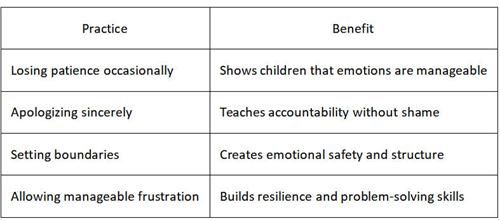
Perfection creates anxiety. Repair creates resilience.
When parents apologize after mistakes, children learn accountability without shame. When parents allow waiting, children learn patience. When parents show vulnerability without collapse, children learn emotional strength.
Boundaries Are Not Distance—They Are Structure
Some parents worry that caring for themselves means neglecting their children. In reality, clear boundaries create emotional safety.
Examples from Daily Life:
A parent saying, "I need ten minutes to calm down" instead of yelling;
Asking children to participate in age-appropriate household tasks;
Declining playtime when depleted and returning later with presence;
These Moments Teach Children:
Others have needs too;
Relationships involve mutual respect;
Emotional regulation is learned, not demanded;
Boundaries protect connection by preventing burnout.
When Parents Carry Unhealed Pain
Some parents find their child's emotions overwhelming—not because of the child, but because of unresolved experiences from their own childhood.
Adults who grew up caring for emotionally unavailable parents often learned to ignore their own needs. When their child expresses distress, it activates old patterns: avoidance, minimization, or impatience.
This is not failure. It is unfinished emotional work.
Healing yourself does not require reliving the past endlessly. It often begins with recognizing patterns and allowing support.
Parents who tend to their own emotional wounds are better able to sit calmly with their child's feelings—without panic, dismissal, or overload .

Practical Ways to Care for Yourself Without Guilt
Self-care does not need to be grand. It needs to be consistent.
1. Micro-Rest
Five minutes of stillness. Deep breathing. No phone. No tasks.
2. Emotional Naming
Saying, "I feel overwhelmed today," reduces emotional pressure.
3. Asking for Help
Support is not weakness—it is sustainability.
4. Personal Identity
Maintaining interests beyond parenting protects mental health.
5. Repair Over Perfection
Apologize when needed. Repair builds trust.
What Children Gain When Parents Care for Themselves
When parents honor their own needs, children grow up learning that:
Emotions are manageable;
Boundaries are healthy;
Rest is allowed;
Relationships are reciprocal;
This is not just good parenting—it is lifelong education.
Conclusion
Parenting was never meant to be self-erasure.
Children do not need parents who disappear for them. They need parents who remain alive inside themselves.
Caring for yourself is not stepping away from your child. It is standing more steadily beside them.
When your inner life is nourished, your presence becomes warmer. When your energy is protected, your patience grows. When you live fully, your child learns how to live too.
Medical Disclaimer
This article is for educational purposes only and does not replace professional psychological or medical advice. Parents facing significant emotional distress, burnout symptoms, or family challenges are encouraged to seek individualized support from qualified mental health professionals.
For immediate support:
National Parent Helpline: 1-855-427-2736
Crisis Text Line: Text HOME to 741741
About the Author
Rachel Donovan, LCSW, is a Licensed Clinical Social Worker with over ten years of experience working with children, adolescents, and families. She specializes in trauma-informed parenting, attachment-based interventions, and family resilience, integrating psychological research with real-world clinical practice.
Her work centers on helping parents build emotionally sustainable, responsive relationships with their children rather than striving for unrealistic ideals of perfection. The author holds an active LCSW license and continues to engage in clinical work within a professional children's mental health institution.
Reviewed by: Sarah Chen, MD, FAAP
Review Date: March 2026
Next Review: January 2027
References
[1]Bandura, A. (2018). Social learning theory revisited. Journal of Behavioral Development, 42(1), 12–24. https://doi.org/10.1177/0165025417722521
[2]Thompson, R. A. (2020). Early attachment and emotional development. Developmental Psychology, 56(3), 413–425. https://doi.org/10.1037/dev0000875
[3]Crnic, K., & Low, C. (2021). Parenting stress and child adjustment. Annual Review of Psychology, 72, 483–507. https://doi.org/10.1146/annurev-psych-010419-050830
[4]Winnicott, D. W. (2019). The concept of the good enough parent. Routledge.
[5]Siegel, D. J., & Bryson, T. P. (2020). The power of showing up. Ballantine Books.
Related Articles
How to Save Your Parent-Child Relationship from the Brink of Collapse
Understanding Childhood Anxiety: A Parent's Guide
The Science of Emotional Regulation for Parents
Recommend for you:

Boundaries and Methods for Healthy Communication with the Biological Family of Foster Children
An informed guide for foster parents, detailing trauma-sensitive communication, boundary setting, and collaboration strategies to build positive relationships with biological families.
When Grandparents Overindulge: Balancing Love with Long-Term Child Development
This in-depth guide explores how to handle intergenerational parenting conflicts with warmth, boundaries, and evidence-based strategies—protecting children’s growth while preserving family relationships.
Couples as Co-Parents: Practical Methods for Mutual Support and Self-Care
This guide offers practical methods for couples navigating co-parenting, emphasizing mutual support, self-care, and the importance of teamwork. Learn how to foster healthy communication and emotional well-being for both partners and their children.
The Grandparent's Role in Modern Parenting: Balancing Experience with Boundaries for Optimal Child Development
Grandparents bring experience, patience, and time to child-rearing, which can complement the parents' goals for education and socialization.