
Effective Praise in Parenting: Science-Backed Strategies to Build Resilient Children

Last Updated: March 27th, 2026
Medically Reviewed by: Sarah Chen, MD, FAAP, Board-Certified Pediatrician
Written by: Dr. Emily Carter, LCSW, Licensed Clinical Social Worker
Key Takeaways
1. Praise is not about saying more kind words, but about what you notice and how you reflect it back
2. Effective praise supports motivation, responsibility, and emotional security without inflating ego
3. Vague, comparative, or misplaced praise can unintentionally increase anxiety or reduce persistence
4. Children grow best when praise focuses on effort, process, choices, and growth over time
5. The most powerful praise helps a child feel seen, not evaluated
Introduction: When Praise Doesn't Seem to "Work"
Most parents praise their children every day. Yet many are surprised when praise doesn't seem to "work"—when children still resist effort, fear failure, or rely heavily on external approval.
In clinical practice, I often hear two seemingly opposite concerns:
"I praise my child all the time, but they seem less motivated."
"I don't praise much because I'm afraid my child will become arrogant."
Both worries point to the same misunderstanding. The issue is not whether to praise children, but how praise shapes a child's inner world over time.
Children don't become confident because they are told they are great. They become confident because someone consistently notices their effort, growth, and choices—and reflects those back in a grounded, respectful way. When praise is done well, it doesn't inflate ego. It builds stability.
What Praise Actually Does in a Child's Mind
Praise is a form of feedback, and feedback is how children learn who they are and what they can influence. Over time, children build their self-image from repeated experiences of being noticed—or overlooked.
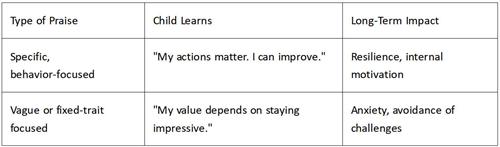
Research in Child Development shows that children who receive process-focused feedback—feedback about effort, strategies, and persistence—are more resilient when facing setbacks and more willing to try difficult tasks
This difference may seem subtle, but it shapes how children approach challenges for years to come.

Common Praise Mistakes That Quietly Undermine Growth
1. Praising Intelligence Can Reduce Courage
Telling a child "You're so smart" often comes from pride and affection. Yet over time, this kind of praise can unintentionally teach children that being capable means not struggling. When difficulty appears, children may avoid it—not because they lack ability, but because they fear losing the "smart" label.
The Research: Children who are repeatedly praised for intelligence are more likely to give up quickly or choose easier tasks to protect their self-image. A 2022 meta-analysis published in Psychological Science found that ability-based praise is associated with higher performance anxiety and lower persistence under challenge
The Fix: Shift praise toward effort and strategies. Instead of "You're so smart," try "You worked through that problem step by step—that persistence helped you figure it out."
2. Empty Praise Leaves Children Without Direction
Statements like "You're amazing" or "Great job" are not harmful, but they are incomplete. They don't tell a child what worked or why it mattered. Over time, children may enjoy the warmth but still feel uncertain about how to repeat success.
Clinical Example: In one family I supported, a child proudly showed his parent a completed project and heard, "That's great!" The child later said, "I don't know what part was good." When praise becomes clearer and more descriptive, children gain a stronger sense of competence and direction.
3. Comparison Praise Creates Invisible Pressure
Praise that compares a child to siblings, classmates, or peers often backfires, even when intended positively:
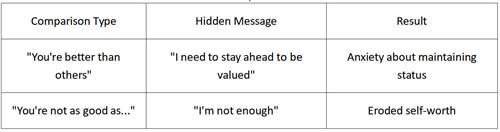
Developmental research consistently shows that children benefit more from self-referenced comparison—noticing progress over time—rather than social comparison
Children grow more steadily when they measure themselves against their own past, not against someone else's performance.
What Effective Praise Looks Like in Everyday Life
1. Focus on Actions Rather Than Identity
When praise shifts from who a child "is" to what a child "did," it becomes more empowering:
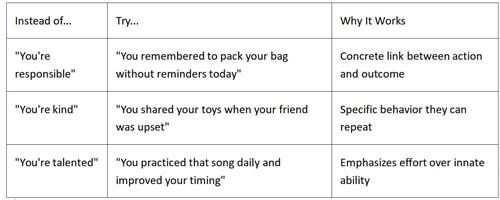
This kind of praise builds responsibility naturally. Children learn that responsibility is something they practice, not a label they either have or lose.
2. Emphasize the Process More Than the Result
Children are more willing to stretch themselves when they know effort is valued even if the outcome isn't perfect.
Case Study: In one family I worked with, a child struggling academically became less avoidant once his parents consistently praised study routines, help-seeking, and persistence rather than test scores.
Research supports this approach. Process-focused praise increases resilience and reduces fear of failure because children learn that mistakes are part of learning, not proof of inadequacy
3. Name the Details You Truly Notice
Specific praise tells a child, "I was paying attention." Naming details—such as careful checking, patience, or thoughtful planning—helps children recognize their own strengths and repeat effective behaviors.
Examples of Descriptive Praise:
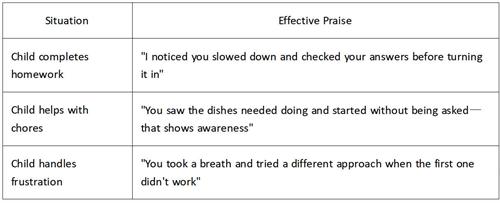
Over time, children internalize these observations and develop stronger self-awareness.
Timing Matters More Than Quantity
Praise Works Best When It Is Timely
Praise is most effective when it comes close to the behavior it recognizes. Immediate feedback strengthens learning by clearly linking action and response. Delayed praise often loses emotional clarity and impact.
This principle aligns with longstanding learning research and is reflected in recent guidance from the American Academy of Pediatrics on effective discipline and encouragement
Simply put, noticing effort while it's happening helps children connect the dots.
Rewards, Motivation, and the Limits of External Incentives
Not Every Responsibility Needs Praise or Rewards
Some tasks—homework, basic chores, daily routines—are part of family life. When every routine behavior is rewarded, children may begin to expect compensation rather than develop internal responsibility.
Research from self-determination theory shows that overreliance on external rewards can weaken intrinsic motivation, especially when rewards replace meaningful feedback
Praise is most powerful when it highlights extra effort, growth, or thoughtful choices rather than mere compliance.
Connection Outlasts Material Rewards
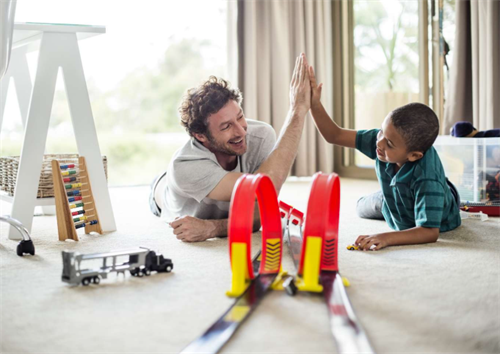
Children may enjoy toys or prizes in the moment, but shared experiences create deeper motivation and emotional security. Families who replace material rewards with time together—walking, cooking, playing, or talking—often see stronger long-term engagement and trust.
Longitudinal family studies emphasize that relational warmth and shared meaning are more predictive of healthy motivation than transactional reward systems
Autonomy, Choice, and Praise That Builds Responsibility
Acknowledge Decision-Making and Follow-Through
Children become self-disciplined by practicing autonomy in small, supported ways. Praise can reinforce this by recognizing planning, decision-making, and responsibility.
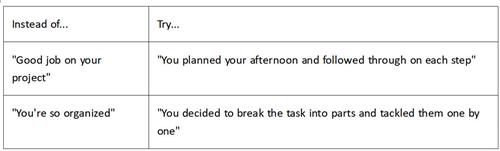
In families where children are gradually included in planning, parents often report fewer power struggles and stronger self-regulation over time.
Balanced Feedback and Emotional Safety
The "5 + 1" Approach Creates Openness to Growth
Before offering one suggestion for improvement, noticing several positives helps children stay emotionally open rather than defensive. This is not about avoiding guidance, but about creating balance.
Children who receive mostly negative feedback often internalize a sense of inadequacy. Balanced feedback supports learning while protecting self-worth.
Praise Builds Psychological Safety
Between the ages of 6 and 14, children are especially sensitive to adult evaluation. In homes where criticism outweighs affirmation, children often become cautious, approval-seeking, or anxious.
Warm, grounded praise contributes to psychological safety, which neuroscience-informed research identifies as essential for learning, exploration, and emotional regulation
Practical Summary: Transforming Your Praise
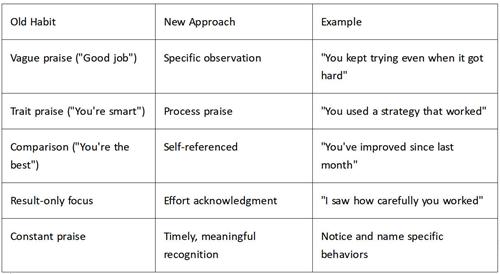
Conclusion: Praise as Guidance, Not Evaluation
Praise is not about making children feel special. It is about helping them feel capable, steady, and seen.
When parents learn to praise with clarity, sincerity, and restraint, children develop:
- Stronger internal motivation
- Healthier confidence
- A more resilient relationship with effort and failure
The next time you want to say, "You're so great," pause for a moment—and tell your child what you truly noticed. That is where praise becomes guidance.
Medical Disclaimer
This article is for educational purposes only and does not replace professional psychological, medical, or educational advice. Parenting strategies should always be adapted to the individual child and family context. If your child shows signs of anxiety, low self-worth, or motivational difficulties, consult a licensed child psychologist or your pediatrician.
Resources for Support:
- Child Mind Institute: www.childmind.org
- American Academy of Pediatrics: www.healthychildren.org
- Find a child psychologist: locator.apa.org
About the Author
Dr. Emily Carter, LCSW, is a Licensed Clinical Social Worker specializing in child development, parenting support, and family systems therapy. She has extensive experience working with parents and children around issues such as emotional regulation, sibling relationships, behavioral challenges, and family transitions.
Dr. Carter's professional focus is on translating evidence-based psychological research into practical, compassionate guidance that parents can apply in everyday life. She continues to engage in clinical work at the Child Mind Institute, a nationally recognized, publicly searchable nonprofit organization in the United States dedicated to children's mental health and family well-being. Her work emphasizes emotional security, developmentally appropriate expectations, and long-term parent-child relationship health.
Reviewed by: Sarah Chen, MD, FAAP
Review Date: March 2026
Next Review: January 2027
References
[1]Haimovitz, K., & Dweck, C. S. (2021). What predicts children's fixed and growth intelligence mindsets? Child Development, 92(4), 1359–1376. https://doi.org/10.1111/cdev.13510
[2]Brummelman, E., et al. (2022). Praise for intelligence can undermine children's motivation. Psychological Science, 33(3), 397–409. https://doi.org/10.1177/09567976211055618
[3]Corpus, J. H., & Wormington, S. V. (2020). Profiles of intrinsic and extrinsic motivation. Contemporary Educational Psychology, 61, 101860. https://doi.org/10.1016/j.cedpsych.2020.101860
[4]American Academy of Pediatrics. (2021). Effective discipline to raise healthy children. https://www.aap.org
[5]Deci, E. L., et al. (2020). Motivation and rewards. Annual Review of Psychology, 71, 489–516. https://doi.org/10.1146/annurev-psych-010418-102803
[6]Harvard Center on the Developing Child. (2023). Serve and return interaction shapes brain architecture. https://developingchild.harvard.edu
[7]Immordino-Yang, M. H., et al. (2022). Emotions, learning, and the brain. Educational Psychologist, 57(1), 1–17. https://doi.org/10.1080/00461520.2021.2015138
Related Articles
How to Save Your Parent-Child Relationship from the Brink of Collapse
Why Parents Who Care for Themselves Raise Emotionally Healthier Children
Helping Your Firstborn Adjust to a New Baby
Recommend for you:

Couples as Co-Parents: Practical Methods for Mutual Support and Self-Care
This guide offers practical methods for couples navigating co-parenting, emphasizing mutual support, self-care, and the importance of teamwork. Learn how to foster healthy communication and emotional well-being for both partners and their children.
How Do Single-Parent Families Talk to Their Children About Absent Parents? (Reference for Different Age Speech Styles)
Learn how to talk to your child about an absent parent with age-appropriate, emotionally supportive strategies. This guide will help you navigate difficult conversations with compassion and clarity.
How to Save Your Parent-Child Relationship from the Brink of Collapse
Licensed clinical social worker shares 7 science-backed strategies to repair parent-child relationships. Learn emotional regulation techniques, communication tools, and stress management from a children's mental health expert.
How Parents Build Strength Through Community—and Raise Stronger Children Because of It
Many parents quietly share the same thought, even if they never say it out loud: “I’m holding on—but I’m holding on alone.”