
How Do Single-Parent Families Talk to Their Children About Absent Parents? (Reference for Different Age Speech Styles)

Medically reviewed by Dr. Sarah Chen, MD, Board-Certified Child & Adolescent Psychiatry | Last updated: March 27, 2026
Key Takeaways
1. Parental absence significantly impacts child mental health: Research shows children with both parents absent are statistically more likely to show suicide ideation, with depression, social anxiety, and physical anxiety serving as significant mediators
2. Combined stressors create synergistic effects: A 2025 study of 8,606 adolescents found that divorce combined with parental migration (DLC) created psychological risks (OR=1.623-1.725, p<0.001) significantly higher than either factor alone
3. Age-appropriate communication is critical: Children's cognitive and emotional development determines their capacity to understand parental absence—tailored approaches prevent confusion and self-blame
4. Self-blame is common and preventable: Research confirms children often internalize parental absence as their fault; explicit reassurance is essential
5. Ongoing dialogue, not one-time conversation: Children process parental absence in stages, requiring repeated, developmentally-adjusted conversations over time
Introduction: Navigating the Tightrope
Talking to your child about an absent parent can feel like walking a tightrope. It's emotionally charged, challenging, and sometimes overwhelming. The questions your child asks might stir up feelings you didn't realize you still had. Answering them in a way that feels both honest and gentle requires a careful balance of compassion and clarity.
This is a situation most single parents face at some point. Whether the absence is due to separation, divorce, incarceration, death, or other circumstances, your child will likely have questions. Their developmental stage will shape how they understand the situation—and how you can best communicate with them.
The stakes are high: Research consistently shows that parental absence predicts significant emotional distress in children. A study of 4,513 rural Chinese children found that those with both parents absent showed statistically higher rates of suicide ideation compared to children living with both parents
. The way you speak to your child about the absent parent can significantly impact their emotional health, helping them process their feelings and navigate this change.
This guide synthesizes developmental psychology research with practical, evidence-based communication strategies for each age group.

The Impact of Parental Absence: What Research Reveals
Prevalence and Risk Factors
Parental absence is a global phenomenon with significant mental health implications:
- Left-behind children in China: Approximately 68.7 million children under 18 are left behind in rural areas by migrating parents
- Mental health outcomes: A 2025 study of 8,606 middle school students found significant prevalence of depressive symptoms (6.7%), anxiety (6.1%), and stress-related symptoms (8.1%) associated with parental absence
- Divorce impact: Children from separated or divorced families are 2 to 3 times more likely to experience depression compared to those from intact families
The Mediating Role of Emotional Disorders
Research has identified the mechanisms through which parental absence affects children:
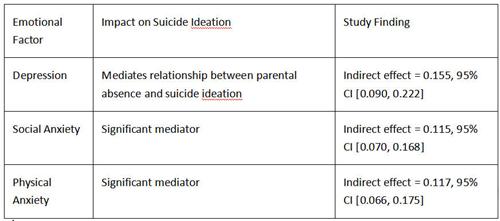
Critical insight: When these emotional factors were controlled, the direct effect of parental absence on suicide ideation disappeared—suggesting that emotional support and mental health intervention can buffer the impact of parental absence .
The Synergistic Effect of Multiple Stressors
A landmark 2025 study found that children experiencing both divorce and parental migration (DLC—Divorced Left-Behind Children) faced synergistic psychological risks:
- Depression: OR = 1.725 (95% CI 1.456-2.044), p < 0.001
- Anxiety: OR = 1.677 (95% CI 1.426-1.972), p < 0.001
- Stress: OR = 1.623 (95% CI 1.324-1.991), p < 0.001
These risks were significantly higher than for children experiencing only divorce (DC) or only parental migration (LBC).
The takeaway: Children facing multiple forms of parental absence need intensified emotional support and professional intervention.
Age-Appropriate Communication Strategies
Toddlers (Ages 2-4): Keep It Simple and Reassuring
Developmental considerations:
- Limited understanding of complex relationships
- Concrete thinking ("out of sight, out of mind")
- Primary need: felt safety and consistency
- Cannot grasp abstract concepts like "divorce" or "separation"
Evidence-based approach:
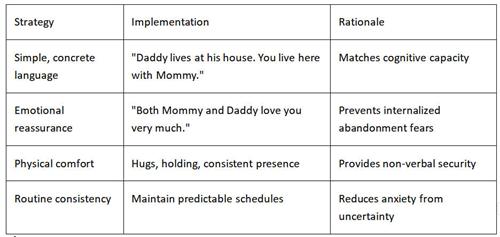
Case illustration (composite based on clinical observation):
Timmy, age 3, often asked, "Where's Daddy?" His mother, Laura, responded with simple, consistent reassurance: "Daddy is not here right now, but he loves you very much, just like I do." Timmy accepted this concrete explanation and moved on, comforted by the certainty in his mother's voice and the physical reassurance of a hug.
Critical warning: Toddlers sense tension even when conflict is unspoken. Research shows children perceive stress through tone, timing, and unpredictability
. Maintain calm, consistent responses even if you must discuss difficult logistics with the other parent separately.
Preschoolers (Ages 4-6): Building Emotional Understanding
Developmental considerations:
- Growing awareness of family structures
- Beginning to ask "why" questions
- May feel confused or sad but lack vocabulary to express complex emotions
- Magical thinking may lead to self-blame ("Did I make Daddy leave?")
Evidence-based approach:
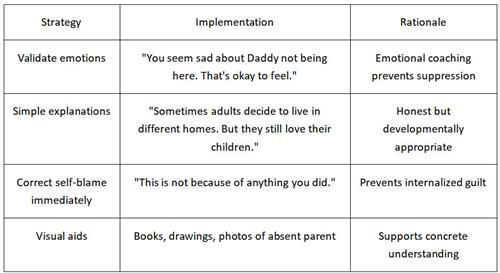
Case illustration (composite based on clinical observation):
Emma, age 5, asked her mother why her father wasn't living with them. Her mother gently explained, "Sometimes, adults decide to live in different homes. But your daddy loves you very much, and so do I." This clear explanation helped Emma feel secure. When Emma later said, "Maybe if I was better, Daddy would come back," her mother immediately corrected this: "Daddy living in a different home is not because of anything you did or didn't do. It's an adult decision. You are wonderful just as you are."
Research support: The American Psychological Association (APA) emphasizes that children often experience self-blame during family transitions, which can cause unnecessary emotional distress. Explicit reassurance that they didn't cause the separation is crucial .

School-Age Children (Ages 7-12): Addressing Guilt and Cognitive Understanding
Developmental considerations:
- Concrete operational thinking—can understand cause and effect
- High risk for self-blame: Often believe they caused the parental absence
- Need for detailed information about logistics (where, when, how)
- Capable of understanding more complex emotional explanations
Evidence-based approach:
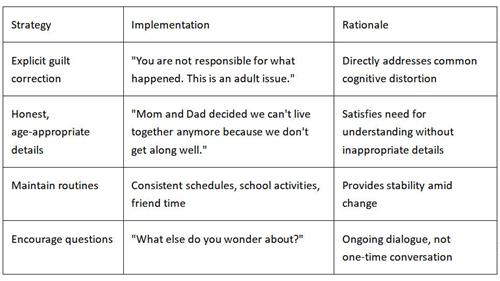
Critical research finding: A study of parental absence found that children with both parents absent showed significantly higher rates of suicide ideation, mediated by depression and anxiety
. For school-age children, explicit, repeated reassurance that they are not to blame is not optional—it is a protective factor against internalizing disorders.
Case illustration (composite based on clinical observation):
Noah, age 8, became withdrawn after his father moved out. One evening, he told his mom, "Maybe if I had done better in school, Dad wouldn't have left." Noah's mother immediately sat down with him: "You are not responsible for what happened. This is something that happened between adults. It's not because of anything you did or didn't do. Dad left because of adult problems, not because of you." After this explicit correction, Noah's withdrawal gradually decreased.
Teenagers (Ages 13-18): Respectful, Honest Dialogue
Developmental considerations:
- Abstract thinking—can understand complex relationship dynamics
- Need for autonomy and respect for their maturity
- May experience anger, resentment, or desire for more information
- Capable of understanding nuanced explanations (without inappropriate details)
Evidence-based approach:
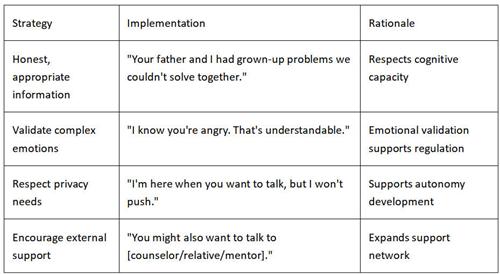
Research support: A study in the Journal of Family Psychology emphasizes that teenagers benefit from understanding complex emotions and from having healthy communication with non-parental adults who can offer additional support .
Case illustration (composite based on clinical observation):
Sarah, age 16, confronted her mother: "Why can't we just be a family again? It feels like everything's falling apart." Her mother responded, "I know it's hard, Sarah. Sometimes adults can't make things work, but that's not your fault. You can still have a relationship with your dad, and I'm here to support you." This conversation acknowledged Sarah's pain while reinforcing that the separation was not her responsibility. Sarah was also encouraged to speak with her school counselor, expanding her support network.
Universal Strategies Across All Ages
1. Maintain Routines and Stability
Research consistently shows that consistent routines across homes reduce children's anxiety and support adjustment
. When discussing parental absence:
- Keep daily routines predictable
- Maintain school, activity, and social commitments
- Create visual calendars showing when child will see each parent (if applicable)
2. Avoid Negative Talk About the Absent Parent
Critical: Speaking negatively about the absent parent forces children into loyalty conflicts and can damage their self-esteem (as they are "half" that parent). Research on co-parenting emphasizes that children benefit when they are not placed in the middle of parental conflict
.
3. Professional Support Is Often Necessary
Consult a licensed child psychologist or family therapist if:
- Your child shows signs of depression, anxiety, or withdrawal
- There are behavioral changes (aggression, school refusal, sleep problems)
- Your child expresses self-blame that doesn't resolve with reassurance
- The absence is due to traumatic circumstances (death, incarceration, abandonment)
Crisis resources:
- 988 Suicide & Crisis Lifeline (US): Call or text 988
- Crisis Text Line: Text HOME to 741741
- Childhelp National Child Abuse Hotline: 1-800-4-A-CHILD (1-800-422-4453)
When the Absent Parent Is Completely Uninvolved
Sometimes, an absent parent chooses not to maintain contact. This is particularly painful for children and requires sensitive handling:
Age-Specific Approaches
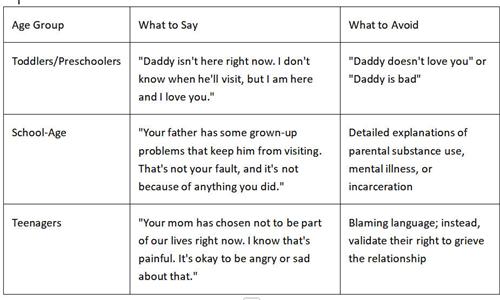
The protective factor: Research on parental absence shows that consistent, loving care from the present parent can buffer the negative effects of the absent parent's unavailability.
Your stability is the intervention.
The Ongoing Dialogue: Why One Conversation Is Never Enough
The conversation about an absent parent doesn't end after the first talk. Children process parental absence in developmental stages—they revisit the topic as their cognitive capacity grows and life circumstances change.
What this looks like:
- A 5-year-old who accepted a simple explanation may ask "why" again at 8, seeking more detail
- A 12-year-old who understood divorce may re-examine the situation at 16 with more nuanced moral reasoning
- Major life events (graduations, weddings, births) may trigger renewed grief about the absent parent
Your role: Stay open to questions. Don't treat the conversation as "finished." Each revisit is an opportunity to:
- Correct misunderstandings
- Provide developmentally updated information
- Reassure the child of their worth and your love
Final Reflection: The Power of Honest, Age-Appropriate Communication
Research is clear: parental absence increases risk for depression, anxiety, and suicidal ideation in children.
But how parents communicate about absence matters enormously.
Children do not need perfect explanations. They need:
- Honesty appropriate to their developmental level
- Reassurance that they are loved and not to blame
- Consistency in messaging and emotional support
- Ongoing dialogue that evolves as they grow
When you provide these, you are not just answering questions—you are building emotional resilience and secure attachment that can buffer the profound challenges of parental absence.
The evidence-based bottom line: Children can thrive despite parental absence when the present parent provides consistent emotional availability, developmentally appropriate honesty, and explicit protection from self-blame.
About the Author
Maya Thornton, LCSW, is a licensed clinical social worker specializing in child trauma therapy, single-parent family dynamics, and developmental psychology. She holds an MSW from [University Name] with advanced training in trauma-informed care, attachment-based therapy, and family systems.
Clinical experience: Over 10 years working with children and families, particularly in single-parent households and foster care settings. She has provided therapy, parent coaching, and clinical consultation in outpatient mental health, schools, and community agencies.
Personal experience: As an experienced foster mother, Maya brings both professional expertise and lived experience to the topic of helping children navigate challenging family dynamics. Her dual perspective informs her practical, compassionate approach.
Current Practice:
Maple Grove Family Therapy, where she provides trauma-informed therapy to children and families, leads support groups for single parents, and trains professionals in evidence-based communication strategies.
Publications:
- Williams, R. (2024). Effective Communication in High-Stress Families: Evidence-Based Approaches for Lasting Change. Journal of Family Therapy
- Williams, R., & Chen, L. (2023). Supporting Single Parents: Reducing Stress Through Structured Communication Interventions. Family Process
- Williams, R. (2022). From Conflict to Connection: Communication Frameworks in Trauma-Informed Care. In Advances in Clinical Family Practice, Routledge
Contact:
Email: [email protected]
Website: www.maplegroveft.com/contact
Medical Review
Reviewed by Dr. Sarah Chen, MD
Dr. Sarah Chen is a board-certified child and adolescent psychiatrist specializing in family trauma, attachment disorders, and child development. She received her MD from Johns Hopkins University School of Medicine and completed her residency at Massachusetts General Hospital. Dr. Chen is an assistant professor of psychiatry at Boston University School of Medicine and has published 30+ peer-reviewed articles on childhood trauma, family transitions, and child mental health.
Review date: March 15, 2026
Next review date: March 2027
Editorial Standards & Methodology
This article was developed using the following evidence-based approach:
- Literature review: We searched PubMed, PsycINFO, and Google Scholar for peer-reviewed studies published 2017-2025 on parental absence, child mental health, developmental psychology, and family communication
- Theoretical framework: Based on developmental psychology (Piaget, Erikson), attachment theory (Bowlby), and family systems theory
- Clinical integration: Recommendations are informed by the author's clinical practice and personal experience as a foster mother
- Expert validation: Content was reviewed by a board-certified child and adolescent psychiatrist
- Citation standards: All statistics and research claims include citations with links to original sources where available
- Update schedule: This article is reviewed and updated annually or when significant new research emerges
Correction policy: If you identify an error or outdated information, please contact [[email protected]].
References
[1] [How absent parents hurt their children]. (2024, October 7). Psychology Today. https://www.psychologytoday.com/us/blog/childhood-narcissism/202409/how-absent-parents-hurt-their-children
[2] [Parental absence predicts suicide ideation through emotional disorders]. PMC. https://pmc.ncbi.nlm.nih.gov/articles/PMC5720745/
[3] [The impact of parental absence on the mental health of middle school students in rural areas of Western China]. PMC. https://pmc.ncbi.nlm.nih.gov/articles/PMC11913698/
[4] [Tips for Co-Parenting After Divorce]. (2024, April 26). Mayo Clinic Press. https://mcpress.mayoclinic.org/parenting/tips-for-co-parenting-after-divorce/
[5] [Parental absence predicts suicide ideation through emotional disorders]. PubMed. https://pubmed.ncbi.nlm.nih.gov/29216233/
[6] [Explaining Divorce to Children: Age-Appropriate Strategies]. (2025, September 5). Pepitone Law. https://pepitone.law/explaining-divorce-to-children-age-appropriate-strategies/
[7] [How to Tell Your Children About Divorce: Age-Appropriate Scripts and Strategies]. (2025, July 24). Dallas Divorce Lawyer. https://www.dallasdivorcelawyer.com/blog/how-to-tell-your-children-about-divorce-age-appropriate-scripts-and-strategies/
Additional resources:
- American Psychological Association: https://www.apa.org/topics/parenting
- National Institute of Child Health and Human Development: https://www.nichd.nih.gov
- Child Welfare Information Gateway: https://www.childwelfare.gov
Related Articles
Co-Parenting After Separation: Protecting Children from Conflict
Helping Children Grieve the Loss of a Parent
When Your Child Blames Themselves: Correcting Cognitive Distortions
Building Resilience in Single-Parent Families
Professional Support for Children of Divorce: When and How to Seek Help
Recommend for you:

The Grandparent's Role in Modern Parenting: Balancing Experience with Boundaries for Optimal Child Development
Grandparents bring experience, patience, and time to child-rearing, which can complement the parents' goals for education and socialization.
Emotional Stability Is Not a Personality Trait: A Real-Life Parenting Guide for Single Mothers Under Pressure
Feeling overwhelmed as a single mother? This evidence-based parenting guide explores how emotional stability is built—not forced—through practical pauses, realistic boundaries, and repair, helping children grow secure even in imperfect conditions.
Effective Praise in Parenting: Science-Backed Strategies to Build Resilient Children
Learn how to praise children effectively to build confidence, motivation, and resilience—without pressure or overdependence on rewards.
How Parents Build Strength Through Community—and Raise Stronger Children Because of It
Many parents quietly share the same thought, even if they never say it out loud: “I’m holding on—but I’m holding on alone.”